

In a market where opportunity moves quickly and disruption is constant, merger and acquisitions are not just strategic options: They are transformative levers. Yet the success of any transaction hinges not only on the timeline of tasks completed, but on the quality of foresight, execution, and alignment behind each decision. A structured timeline is essential, but it’s just one dimension of a much broader deal ecosystem.
Beyond the Timeline: What Defines an Effective Merger and Acquisitions Execution
A common misconception is that a checklist-driven timeline is sufficient to bring a deal to the finish line. In practice, it’s the interconnectivity between strategy, technology, and governance that turns potential into performance. Before initiating due diligence, executive sponsors and deal teams must align on a shared vision. One that balances growth with operational realism. This foundation ensures that strategic objectives do not drift as new information is uncovered.
Equally important is the ability to remain agile throughout the deal lifecycle. M&A landscapes can shift overnight due to regulatory feedback, leadership changes, or competitive counteroffers. Agile planning, anchored by strong governance, enables teams to reprioritize without losing momentum or compromising risk management.
This is particularly true during post-close integration. The failure to adapt legacy processes or cultures can erode the value created during negotiations. Maintaining continuity across people, systems, and communications is what ensures lasting value and stakeholder confidence long after the deal closes.
Modern M&A also demands transparency and control. As deal complexity grows, manual processes and disconnected communication expose stakeholders to inefficiencies and data vulnerabilities. Organizations that leverage secure collaboration tools are better equipped to manage document integrity, workflow access, and real-time communication across geographies and disciplines. These platforms are not just for storage; they become the digital foundation of deal continuity.
Building the Right Team and Framework
No two M&A transactions are the same. The most resilient deals are backed by cross- functional leadership and integrated advisory support. Legal, financial, and operational leaders must work in concert, not as independent contributors, but as a single, cohesive unit. Early alignment on key metrics, risk thresholds, and cultural priorities minimizes downstream rework and enhances confidence from both internal stakeholders and external regulators.
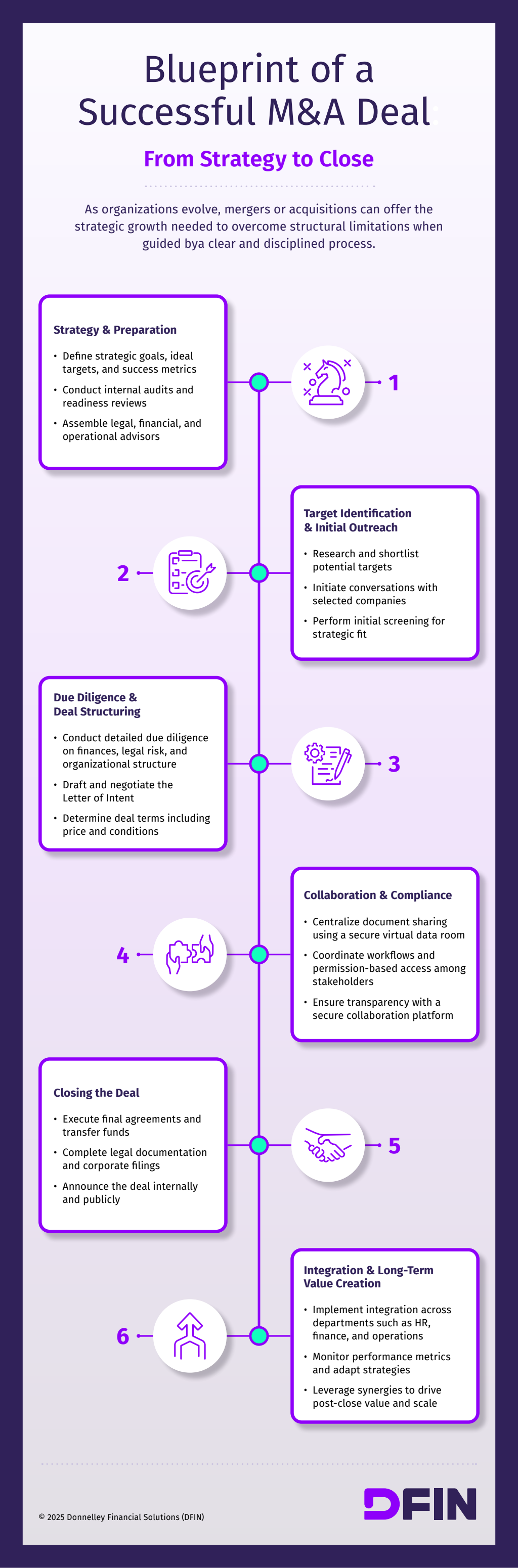
Ultimately, the timeline is a critical visual tool, but it should function in service of a broader, well-integrated approach. When structure meets flexibility and transparency is built into every step, organizations can move with speed and confidence through even the most complex transactions.
For a visual breakdown of the M&A process from strategy through integration, explore the companion resource from Donnelly Financial Solutions, a provider of SEC reporting services.

- Building M&A Success: Strategy, Flexibility and Execution
- Avoiding the Recall Spiral: Why Equipment Design Demands Greater Focus
- The Foundation of Merger And Acquisitions Success: Strategy, Flexibility, and Precision
- For Manufacturers, Quality Control Should be a Sales MVP
- Investing in Retention: How Benefits Support a Stronger Workforce